
Double the Impact with “Training Mentors” and “Ready to Go”
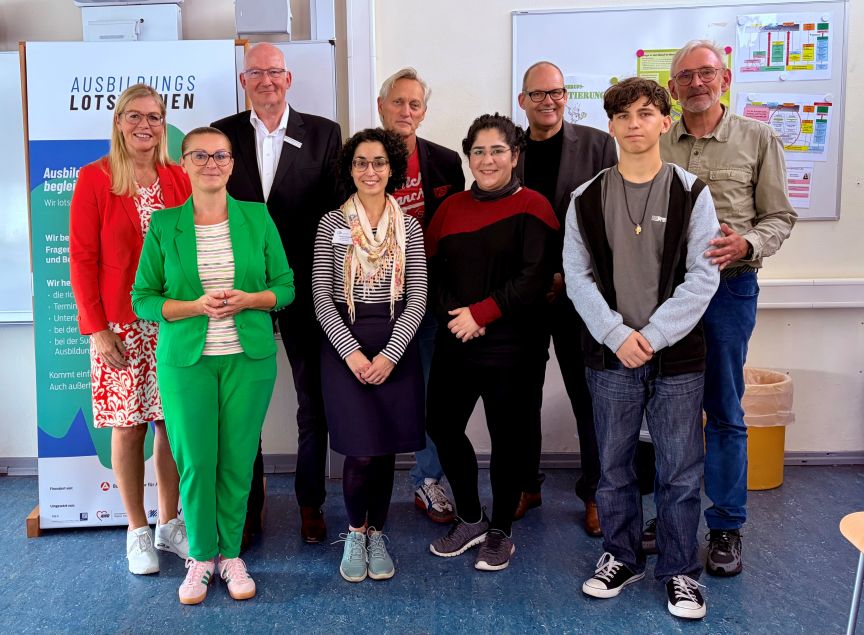 © Region Hannover
The transition from school to a career is a challenge for many young people. For over ten years, the Region Hannover’s vocational guidance counselors have been supporting students on this path—with success: Each year, over 9,000 young people benefit from additional career guidance, job application training, and internship placement. This has prompted the Region Hannover to increase funding by another 200,000 euros to include six new schools in the project.
But what if social or mental health issues cloud their view of the future? This is precisely where the new partnership with the “Startklar” project of the Hannover Region Job Center comes in. Since August 1, both projects have been working hand in hand at 18 schools in the Hannover region to provide even more targeted support to young people.
The career counselors have demonstrated consistent success in recent years: They help students recognize their strengths, discover suitable career fields, and apply for jobs successfully. But reality shows that not all young people are immediately ready to grapple with these issues. Some struggle with social difficulties, mental health challenges, or family problems that initially make career planning impossible.
This is where “Startklar” comes in. The new project from the Jobcenter Region Hannover specializes in helping young people facing these challenges find stability at schools with career guidance counselors—whether through social-educational support, working with parents, or connecting them with appropriate support services. The Hannover Region Job Center is funding the project with a total of 1.5 million euros. The “Startklar” concept emphasizes the close integration of both projects: At the six new schools (including Leibniz IGS Langenhagen, IGS Seelze, and KGS Laatzen) as well as at twelve of the 27 existing schools, the training guides will be working equally on both projects starting in August.
What does the integration of training guides and “Startklar” mean?
- No hand-offs, no loss of momentum: The young people are supported by a single point of contact—from social stabilization to concrete career guidance.
- More time for individualized support: By doubling the staff at the 18 schools, the needs of the students can be addressed even more effectively.
A holistic approach: The “Startklar” program lays the groundwork (e.g., through social-educational support), while vocational guidance counselors assist with the transition from school to work, provide career guidance, and help students secure apprenticeships or admission to secondary schools.
What specifically is changing—and who is taking on which tasks
The six new schools were selected in close consultation with the Employment Agency and the Hannover Region Job Center. Criteria included, among other things, the proportion of SGB II benefit recipients in the municipality’s total population or a school’s student body, as well as a specific need for support in career guidance, as reported by the Employment Agency’s career counselors.
The training guides are continuously present on-site at the schools and serve as a liaison between the school, the business community, and the young people. Their responsibilities are diverse and include:
- Group activities in the classroom or in small groups (e.g., in grades 8–10) that are tailored to each school’s career guidance program.
- Individual support for students—e.g., job application training or placement in internships.
- Networking with businesses, vocational schools (BBS), and professional associations to organize internships, trial classes, or apprenticeship positions.
- Career orientation assessments in pre-graduation and graduating classes to ensure thatevery studenthas a clear path forward after graduation.
- Introducing and supporting an individualized career roadmap that serves as a guide for students’ professional futures.
While the vocational guidance counselors focus on career guidance, “Startklar” provides the preliminary social-educational support. This includes:
- Individual support for students facing social or mental health challenges.
- Working with parents to involve the students’ support network in the process.
- Follow-up support for students entering vocational training or vocational high school to ensure a smooth transition.
- Collaboration with external partners (e.g., youth welfare services, school social workers) to develop holistic solutions.
Press Contact
Christoph Borschel
Contact
Katharina Goethe
Hanover Region
Employment Promotion
Department of Economic and Employment Promotion