
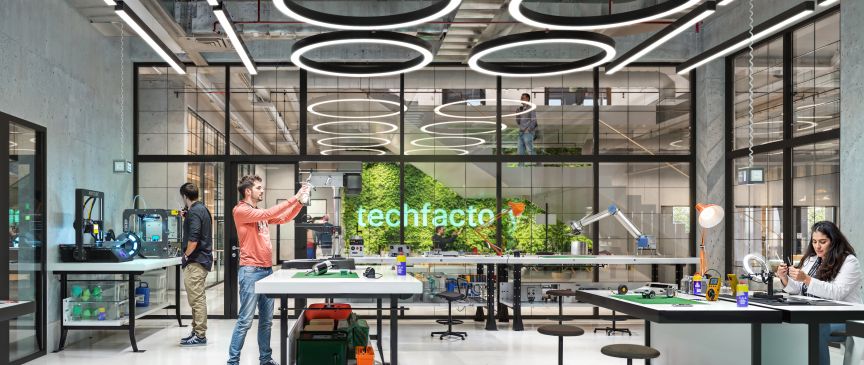
 © loomn architekturkommunikation (LMT3 Architects)
Trends and Facts: The Economy in the Hanover Region in Transition
Structural change in the Hanover region is driving growth in sectors such as the energy industry and knowledge-based services, while traditional industries are under massive pressure. This is shown by the latest analysis, “Trends and Facts 2025,”from the Hanover Region’s Economic and Employment Development Office, which is now available at the following link. The number of employees subject to social insurance contributions has risen by 67,000 to 548,000 over the past ten years; however, the pace of growth has slowed significantly in recent times.
Which industries are the economic winners in the Hannover region?
The current winners of the transformation are clearly identifiable: The energy sector is experiencing the strongest upswing, with 8.7 percent annual employment growth and 2,300 new jobs since 2020, significantly outpacing the national trend. The main drivers are companies working on solutions for the energy transition, ranging from wind power and hydrogen to storage technologies. Knowledge-based services (+3.2%, +6,400 jobs) and the healthcare sector (+1.8%, +7,200 jobs) are also developing particularly dynamically. In this context, science and technology professions are experiencing a veritable boom: IT and ICT professions grew by +4.6% since last year alone, while mathematics, biology, and physics professions grew by as much as +7.1%, and environmental protection and geology professions by +3.7%.
Which industries are the economic losers in the Hanover region?
However, structural change also creates losers: The automotive industry loses 0.5% of its employees subject to social insurance contributions annually (-600 jobs since 2020). Even harder hit is mechanical engineering (-1.3% p.a., -800 jobs), which is suffering from global competition and automation. The trade fair and convention industry (-3.8%, -250 jobs) is also struggling with changing realities. As a result, traditional occupations such as metalworking (-17%) and mechanical and automotive engineering (-2.7%) are losing ground.
What is the situation on the labor and training market in the Hanover region?
Despite growth in future-oriented industries, the labor market in the Hanover region remains tight. The unemployment rate rose to 8.1 percent in 2025 (2022: 7.1%). Young people between the ages of 15 and 24 are particularly affected, with the number of unemployed rising to over 4,600 (7.0%). At the same time, the shortage of skilled workers is becoming increasingly noticeable: Currently, 83,000 young people are pursuing vocational training or a degree in the region—a decline of about 7 percent compared to 2020. Technical professions such as electrical, metal, and automotive engineering, as well as health and social care professions, are particularly in demand for vocational training.
What’s the story behind the technology parks in the Hanover region?
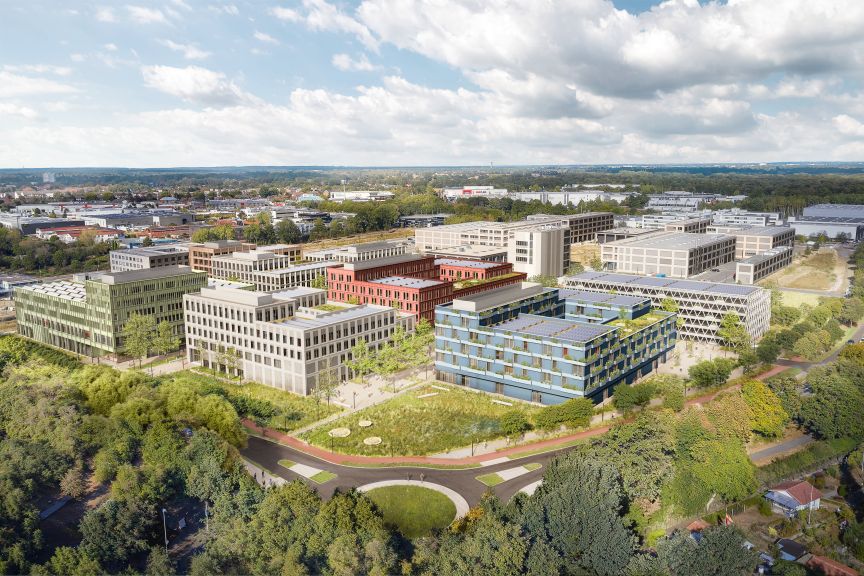 © loomn architekturkommunikation (LMT3 Architekten)
Both projects combine several key factors
- They strengthen the labor and training market by creating new jobs in future-oriented fields.
- They offer young people opportunities—through affordable student housing and direct engagement with academia and businesses.
- They make the Hanover Region attractive to investors, startups, and talent from all over Germany and beyond.
Nordstadt Site
On the grounds of the Region Hannover Medical Center, in the immediate vicinity of the university’s main campus, ten vacated hospital buildings spanning approximately 25,000 square meters will be repurposed for new uses by 2034. The first startups and companies will move in starting in late 2027. The focus is on artificial intelligence, cybersecurity, and the natural sciences. The concept is complemented by affordable housing, laboratories, offices, and dining options.
Garbsen Location
A modern technology park is being developed on the Mechanical Engineering Campus in partnership with private investors. Techfactory will move into the new ONE TechCampus (asto Group) as a tenant. The first construction phase will begin at the end of this year, with completion scheduled for the end of 2028.
“Trends and Facts” 2025 is available for download here as a PDF brochure.