
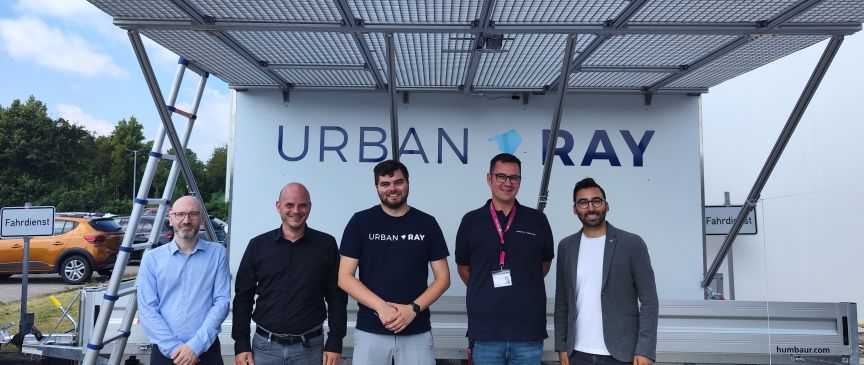
 © Region Hannover
Successful Flight Operations for a Healthcare System Under Cost Pressure
In collaboration with the MVZ Labor Limbach Lehrte, drone operator Urban Ray is using automated drones to transport medical samples through the airspace between Hannover and Lehrte. This makes the Hannover Region one of the first in Germany where lab samples are transported by drone as part of daily operations—a concrete step toward faster, more efficient, and more sustainable processes in patient care.
What had previously existed as a concept and pilot project was implemented under real-world conditions in and around Lehrte from Tuesday, June 30, through Thursday, July 2: Urban Ray, a provider of automated drone logistics, conducted a live operation in collaboration with MVZ Labor Limbach Lehrte to transport laboratory samples by drone. The fully automated flights connect a collection point for lab samples from family doctors’ offices in Hanover with the lab in Lehrte—in real-world operations and using actual medical samples.
From the doctor’s office to the lab—by air instead of in traffic
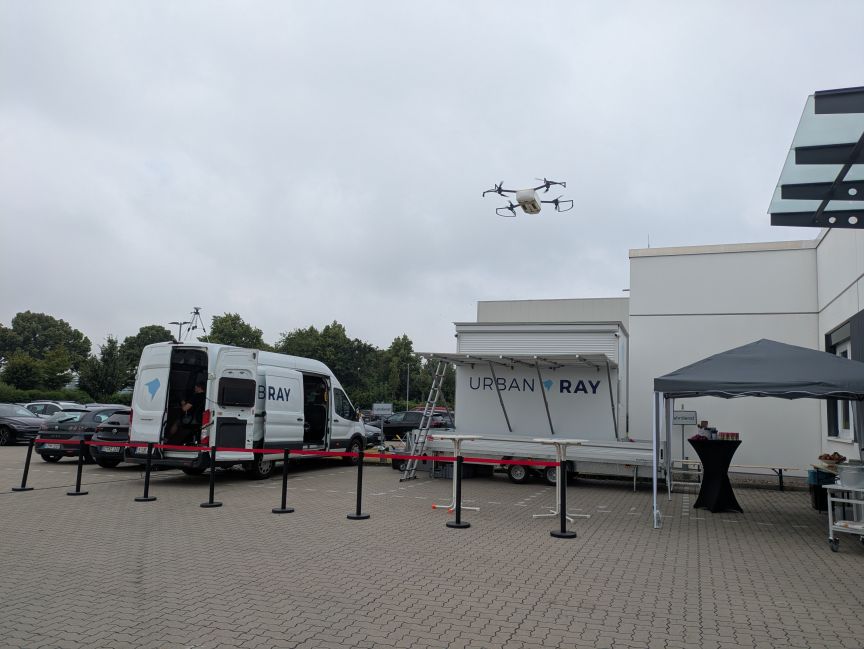 © Region Hannover
Every day, samples are collected at family doctors’ offices and transported to the lab for analysis. Every hour lost along this route can be medically significant. The drone transport initiative launched by Urban Ray aims to shift this route from the road to the air. The drones fly at speeds of up to 70 km/h, are unaffected by traffic and congestion, are fully electric, and can be tracked live at all times. The drones operate in the urban areas of Lehrte, Sehnde, and Hannover. Compared to a car, this mode of transport is more than twice as fast—and serves as a reliable part of the daily routine.
The key factor here is its practical use in everyday life: where vehicles previously followed fixed routes, got stuck in traffic, and wasted time on the road, the drone creates predictable, fast, and eco-friendly connections. Efficiency and sustainability aren’t just buzzwords here—they’re the result of every single flight.
Innovation that works in everyday life
At the heart of the operation are the drone hubs developed in-house by Urban Ray. They load, secure, and launch the drones fully automatically, without the need for on-site staff intervention. This is precisely what makes the system particularly practical: It can be integrated into existing workflows without additional effort and relieves the burden on lab staff rather than placing additional demands on them. The fact that the system is fully electric also makes it a sustainable alternative for daily transportation.
A Solution for a Healthcare System Under Cost Pressure
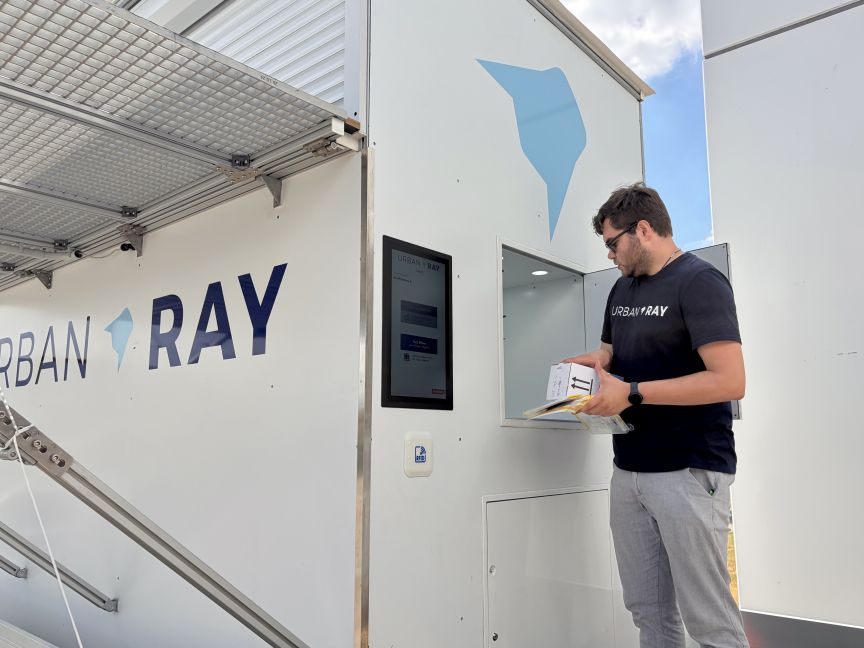 © Region Hannover
Staff shortages, rising costs, and growing demands: The healthcare system is coming under increasing pressure, and in logistics in particular, much potential remains untapped. Automated drone logistics addresses this very issue. It speeds up delivery times, reduces the workload on staff, and makes transportation more predictable—thereby making a concrete contribution to deploying scarce resources where they are most urgently needed: in patient care.
Region Hannover as a Pioneer in Automated Medical Logistics
The flight days clearly demonstrate this: The Hannover Region is emerging as one of the first locations in Germany where automated drone logistics is actually being used in the healthcare sector. This is also a matter of economic strength. Here, Urban Ray—an innovative drone operator from the Rhineland—and the Limbach Nord Laboratory—a high-performance medical laboratory—are collaborating—a partnership that transcends regional boundaries, connects technology and patient care, and positions the region for the future.
What was demonstrated today between the collection point in Hannover and the laboratory in Lehrte will help make medical logistics throughout the region more efficient and sustainable in the future—and thereby permanently improve care for patients.
Contact
Arne Schütt
Hanover Region
Economic Development
Department of Economic and Employment Development

Melanie Albrecht
Hanover Region
Economic Development
Department of Economic and Employment Development