
MIPIM 2026
 © Runze & Casper
As the state capital and economic center of Lower Saxony, Hanover – like many other major cities – is facing profound changes: the redevelopment of city centers, the transformation of mobility, the
housing shortage and new working environments are shaping the real estate industry. The city is actively addressing these challenges and positioning itself as a pioneer for intelligent, sustainable, and livable urbanity. According to the latest Bitkom Smart City Index, Hanover is the "Rising Star of the Year" among German smart cities. With its smart city initiative, the city is driving forward digital, ecological, and citizen-oriented development—for example, through digitized administrative services, innovative mobility and environmental solutions, and networked infrastructure projects.
Hanover as a real estate location: bold ideas and successful transformation
The various aspects of the transformation of the city center and the revitalization of former industrial sites fit seamlessly into this strategy. A master plan has been drawn up and approved for the northern station district, which envisages a gradual redesign of the entire district in the coming years, with a particular focus on the mobility transition and climate change adaptation measures. The management of brownfield sites has also been established as a central task of sustainable land management. For example, the state capital of Hanover is working with the landowner to examine the potential for sustainable urban development on the approximately 90-hectare former Deurag-Nerag industrial site. The former refinery site is currently contaminated with unexploded ordnance and pollutants in the subsoil.
A technology and innovation hub with appeal
The Hanover region is Lower Saxony's strong industrial location, which focuses on innovation, technology, and sustainability in order to develop further. A key project is the Techfactory – a state-of-the-art deep tech start-up center that connects research, start-ups, and established companies. Two locations are planned: at the Maschinenbau Campus Garbsen – a renowned research location of Leibniz University Hannover – and in Hannover's Nordstadt district, near the Leibniz University's central campus there.
The first construction phase at the Garbsen campus covers 13,000 m², of which 4,600 m² will be dedicated to the Techfactory as the "heart" of the development there. Completion is scheduled for spring 2028. The project is one of the most significant investments in deep tech start-up promotion in Germany and strengthens the region's position as a leading technology location.
Garbsen: An attractive location for technology and business
As the second-largest city in the Hanover region, Garbsen offers ideal settlement opportunities for technology-oriented companies and investors at the Mechanical Engineering Campus. In addition to research infrastructure, space is available for residential construction and commercial development.
Personal exchange at MIPIM
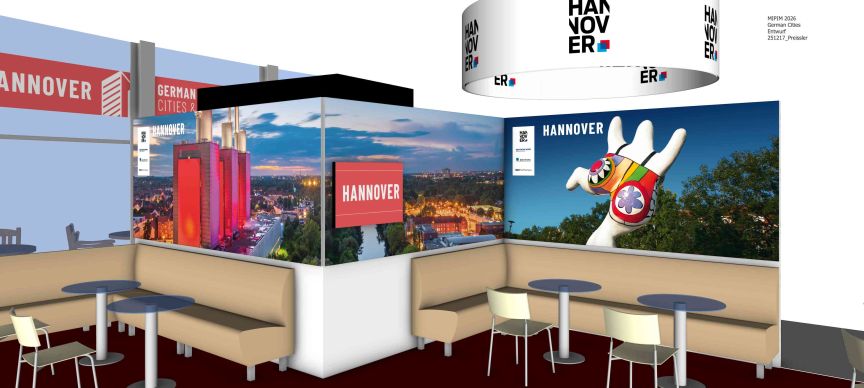
Find out about our strategies for smart urban development, technology transfer, and investment opportunities. Available on site:
- Belit Onay, Mayor of the State Capital of Hannover, with Anja Ritschel, Head of the Department of Economic Affairs and Environment, and Thomas Vielhaber, City Planning Officer
- Ulf-Birger Franz, Head of the Department of Economic Affairs and Transport, Hanover Region
- Christian Peters, First Deputy Mayor of the City of Garbsen
The delegation is completed by its private partners asto Group, Deutsche Hypo – NORD/LB Real Estate Finance, and KSB INTAX. Together, they position Hanover as a leading location for innovative and sustainable real estate projects.
Don't miss: Belit Onay at the "Intelligent Transitions" session
How intelligent systems can accelerate decarbonization in the construction and real estate industries as well as
energy networks.
Tuesday, March 10, 2026, 4:10 p.m. to 5:10 p.m., Road to Zero Stage (P3)
Contact
Sylvia König-Hapke
Hanover Region
Department of Economic and Employment Promotion
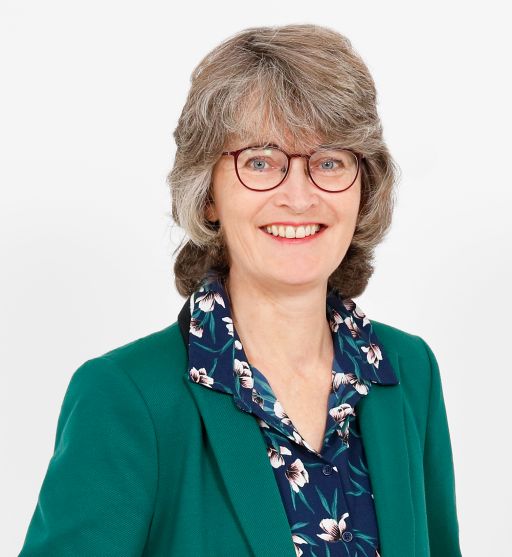
Laura Hansmann