
Urban Air Mobility – Potential Study for the Hanover Region
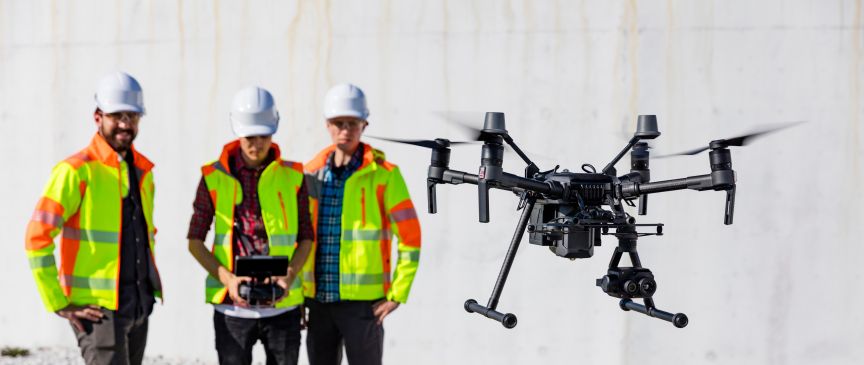
Urban air mobility is rapidly developing into one of the most dynamic future markets worldwide. Drones and unmanned aerial systems are opening up completely new possibilities for logistics, security, and mobility – especially in urban areas. At the same time, the legal basis for commercial use is becoming increasingly concrete, even though the final regulatory and approval framework for UAM in Europe is still pending. Approvals by the Federal Aviation Authority and the EU Commission remain challenging, but can now be planned realistically for the first time.
The Hannover region is pursuing clear goals: to open up new UAV business areas and, among other things, to implement innovative logistics projects in a targeted manner – with real added value for the regional economy and society.
Objectives and results of the potential study
The aim of the study was to lay the foundations for a structured entry into urban air mobility. The focus was on:
- Identification of suitable flight corridors,
- options for central takeoff and landing sites against the backdrop of a hub approach,
- and a sensible sequence for implementing fields of application.
As a result, five key areas of application for urban flying were identified:
Rescue, security, service, cargo, and passenger.
By far the greatest implementation potential currently lies in the area of rescue – especially for first responder operations in accidents and fires, as well as for the rapid transport of medicines.
To effectively cover the entire Hanover region, five superordinate hub locations would be necessary: four in surrounding municipalities and one central hub in the state capital of Hanover.
First use case: Rescue
The rescue use case is the ideal entry point into urban air mobility. Hospitals and laboratories are ideal central partners – for example, for the rapid exchange of laboratory samples, blood reserves, and medicines, and to support first aid in emergencies.
Even though specific flight corridors have not yet been approved under aviation law, this use case offers decisive advantages: it creates a positive frame of mind among the population, demonstrates the social benefits of drone use, and lays the foundation for established flight routes that can later be used for other applications such as B2B cargo.
The potential study clearly shows that urban air mobility is no longer a topic for the future – it is a real opportunity for the Hanover region to position itself as a pioneer at an early stage.
Contact
Melanie Albrecht
Hanover Region
Economic Development
Department of Economic and Employment Development

Arne Schütt
Hanover Region
Economic Development
Department of Economic and Employment Development